

Being a multi-disciplinary freelance creative
With Christy Ku

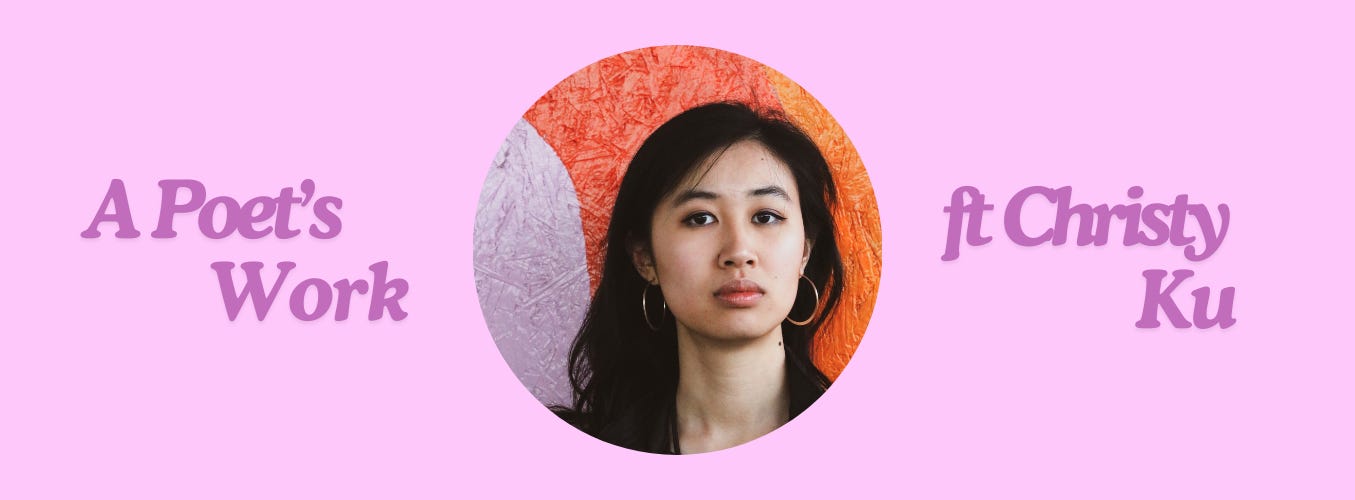
Photo credit: Beth Baker
Christy Ku is a powerhouse of creativity, kindness and wisdom. She brings this to her freelance work in poetry, acting, photography, workshop facilitation, prose writing and more. I don't know how she does it all so I sat down to ask her.
Rachel: So how did you get into poetry?
Christy: Ah, my origin story! At university I studied creative writing and as part of my course I had to do a poetry module. At the same time, my friend Amani Saeed set up a spoken word society. It was a quiet and intimate space to learn and hear other people. Those two things combined got me interested. And then I just carried on! I moved to London after graduating and did a lot of open mics and got involved in the community. I also entered competitions and programmes. It all built up, and here I am!
Rachel: And now you do poetry, photography, acting, prose writing and workshop facilitation. How did you get into being a multi-disciplinary creative? How did you learn all those skills?!
Christy: I've always been interested in many disciplines. I didn't have much opportunity to explore them when I was young because I had very strict parents. My university rebellion was learning how to edit videos, do drama and use Adobe Suite. I tried to take everything I could from having that space to pursue interests outside of my degree through societies. As you get good at something and build a portfolio, people will ask, "Can I hire you?"
With photography, I moved through a few cameras until I got a decent one and I took a lot of photos! Like with poetry, I just kept carrying on, finding and making opportunities. London is a great place to be - there are so many people, resources, opportunities and programmes.
With acting, it is challenging and I do feel new to it. I've also aged out of a lot of development opportunities and the acting world feels more closed off. But my poetry experience has been a huge help. I've been doing a lot of work lately as an extra for film and TV so I've been meeting more actors. I've found these actors are not all that mystical about the craft. They treat it like it's not that deep, and they actually get the jobs!
With workshop facilitation, I'd always been interested because I attend a lot of workshops. I did a leadership programme called Sour Lemons (sadly now dissolved) where we had opportunities to facilitate workshops for each other. It was great practice. If you have friends who are interested in writing, ask if you can run a writing workshop for them. Then you can say on your CV - "I've facilitated workshops for small collectives!". I also found that because I had some big names on my CV from my poetry work (the BBC, Sky Arts) that's opened workshop facilitation doors too.
With prose writing, once you can write, you can write in other mediums. Ultimately the foundation is there. I did a few years of journalism for a YouTube and internet culture publication (also sadly now dissolved) which was great practice. I took a break to focus on poetry but I'm wanting to get back into it so I've been pitching for personal essays lately - we'll see how it goes!
Rachel: What prompted you to go fully freelance?
Christy: I dreamed of a nice office job where I sat at my laptop, chatted with my colleagues, and did poetry on the side. Although that dream didn't feel that big, it didn't happen. The work environments were toxic in so many of the places I found myself. Even in places that claim to have a "flat hierarchy" or be "like a family", colleagues would pull rank and shut down the smallest suggestions. I went to the doctor at one point because I'd skipped a period from stress. I moved through about four start-ups and then I just felt I had to go freelance. Now I can be my own work culture.
Rachel: How do you find that your multi-disciplines influence your poetry?
Christy: Something I love about portrait photography is that the person can finally see themselves how you see them. You can capture their inner personality. I do this in my poetry too. I'll write little bits inspired by something someone has said or done, or inspired by something about them.
For workshop facilitation, I work with different age groups. Seeing how young kids approach creativity is really interesting. In one workshop, I said "Let's write about the moon". One participant wrote about Chinese mythology, one wrote about the moon as cheese, one wrote about werewolves. Same prompt, very different directions and styles. I love seeing that.
Rachel: Is there anything about being a multi-disciplinary person that doesn't support your poetry?
Christy: It's just time. Sometimes I wonder if I should strike a skill off my list if I haven't done it in ages. Or I wonder, what's my main thing? For example, I finished writing my poetry pamphlet in late 2020 and then I didn't write a poem for two years. That makes me question what my "main thing" is. But I'm thinking about it like a fallow period, where you leave the ground alone again to become rich again. And having many disciplines is nice because I can always move on to something else when I can't do one of them.
Rachel: I've found that most poets, when you actually talk to them, have had periods of their lives when they don't write. Some I really want to pick at in these conversations is the idea that one specific thing, one way of being or working or one experience, can validate or invalidate you as a writer.
Christy: I remember in my early days I wondered at what point I would get to call myself a "poet"? There is no governing body. No one will knight you or give you a certificate. It's fine to give it to yourself. But then you worry, of course, what if I'm one of those people who has given themselves a title they don't deserve? For me it was when I first got a commission, or maybe when I first got booked as a headliner, that I decided to call myself a poet. But then again, there are poets I hugely admire who haven't yet published collections, for example, and I consider them poets. It's really not that deep. We need to get over ourselves about it.
Rachel: I completely agree. For me, I called myself a poet only when I had my pamphlet accepted for publication. But then I'd rather be a bad poet, labouring under delusions of grandeur, than no poet at all if those are my options! So, thinking about the future, what are your goals for your work? What are you excited about?
Christy: I'd like to get my poetry pamphlet published and work up to a full collection. The pamphlet has been shortlisted a lot recently which is exciting but I'd like to get it accepted! With acting, I'd like to take on bigger roles… in general I want to continue to build on what I'm doing.
In terms of very big goals… I grew up listening to Gorillaz and the band members do experimental tracks sometimes where they bring on poets and writers. I'd love to be on a Gorillaz album one day. I'm also obsessed with BTS…
Rachel: I'm obsessed with Blackpink! I would love to be a poet on one of their songs.
Christy: Each BTS member does mixtape projects that are more experimental. RM is the member most interested in lyrics and books and art galleries, so maybe one day he will come across my work. If RM ever wants me on a mixtape, hello! Make me your Warsan Shire.
Rachel: What is one piece of advice you would give to someone interested in becoming a multi-disciplinary creative?
Christy: Accept you will be bad at new skills at first. Approach learning as if you're a child, starting from zero years old, and remember there's a lot of gift in being a beginner.
Rachel: And finally, what is one thing that someone reading this newsletter can do to support you?
Christy: Join me in my internet world so you can keep up to date with my work. You can follow me on instagram or TikTok, or sign up to my newsletter.
Rachel: P.S. Christy is a great follow! I love following her social media, her internet world is a great place to be